
“I know I should eat more fruits and vegetables but somehow, I just don’t do it.”
“I rarely buy fruit; it goes bad before I get around to eating it.”
“Do frozen veggies have any nutritional value…?”
Most athletes are well aware that fruits and vegetables are health protective, good for the gut, and better than vitamin pills. Many athletes also report they eat too few of them. If you are among those who bemoan, “I know I should eat more fruits and veggies; I just don’t do it,” this article can help you enjoyably—and economically—boost your intake of these health-protective sports foods.
Tip #1. Pair fruit with protein to make it more enticing.
When you are very hungry, a piece of fruit is unlikely your #1 snack of choice because your body wants calorie-dense food. To make low-cal fruit more appealing, pair it with protein: banana + peanut butter, grapes + cheese, raisins + almonds. This fruit-based snack now becomes a snack of choice because it is more satiating (and tastes yummier, IMO).
Tip #2. Eat veggies by the pile, not by the single serving.
The more veggies (and fruit) you eat, the more nutrients you get. A stalk of cooked broccoli offers all the vitamin C you need for the day, as does half a green pepper. Could you fortify your body by eating a bigger pile of broccoli? Munching on the whole pepper?
Ideally, we should enjoy a veg (or fruit) at each meal to add important nutrients. If you don’t/won’t/can’t do that, at least once a day, try to eat a lot of whatever produce is easiest for you to incorporate into your sports diet: a big bowlful of salad; pre-dinner appetizers of baby carrots, cherry tomatoes, and/or cucumber; the whole 4-serving bag of frozen broccoli.
Tip #3. Fruits and vegetables offer similar nutrients, so you can swap one for the other.
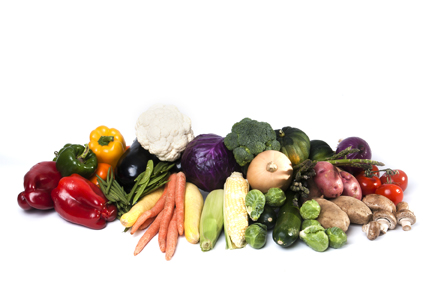
Fret not if you don’t enjoy red tomatoes. Instead, eat red strawberries, red apples, or red peppers. Of greater importance than fruit or veg is to eat a variety of colors:
RED strawberries, apples, watermelon, tomato.
ORANGE oranges, mango, papaya, sweet potato.
YELLOW pineapple, peaches, summer squash.
GREEN kiwi, grapes, broccoli, spinach, kale, pepper
BLUE/PURPLE blueberry, plums, eggplant, grapes
WHITE banana, onion, potato, cauliflower
In general, over the course of the week or month, you want to consume a rainbow of colors for health benefits. How about smoothies loaded with white banana, orange mango, and red raspberries? Or a variety of colorful fruit juices: tart cherry, grape, tomato, orange? Each color offers anti-inflammatory compounds (phytonutrients). In general, deeply colored produce (such as spinach, berries) is nutritionally preferable over paler options (celery, honeydew). Each deep color offers anti-inflammatory compounds that enhance recovery.
Tip #4. To save money and simplify food prep, buy frozen fruits and vegetables.
Many athletes end up tossing out the rotting produce they failed to eat before it spoiled; that is a regretful waste of money. Their solution: stop buying fresh produce. If that’s your case, here are some better ways to reduce food waste:
• Buy frozen vegetables and fruits. Freezing retains nutrients, so rest assured, frozen produce offers full nutritional value. In fact, frozen veggies are often more nutritious than fresh, if fresh simply means unprocessed. For example, the head of fresh broccoli you bought may have traveled for a week from California to Boston, spent a day in the food warehouse, another day at the grocery store, and then another day or two in your refrigerator before you got around to eating it. During that time, the broccoli lost some nutritional value due to exposure to light and air. Hence, the freshest vegetables are often in the frozen food aisle (unless, of course, you shop locally at a Farmer’s Market or grow your own veggies in your garden). Frozen produce is picked at its peak ripeness, all prepped and ready to be cooked—far easier than peeling, slicing, and dicing, especially when you are ravenous and want food NOW!
• Choose frozen berries, mango, and other fruits for making thick and frosty smoothies and protein shakes. Easier to prepare and no waste.
• Take advantage of the grocery store’s salad bar to eliminate wilted salad ingredients and rotting veggies in your refrigerator. Buy just what you need for that day’s meal.
• Cook a whole bunch of veggies at once, so they don’t have the chance to spoil. Plus, you will have enough for easy eating the next several days. For example, pre-cook in the microwave oven the bag of fresh spinach, so it will be ready and waiting to be added to an omelet or bowl of soup—and not be spoiling in your refrigerator. Make a big pot of ratatouille with eggplant, tomato, zucchini, and onion—enough to enjoy for the week (or store in the freezer for future enjoyment). Bake several (sweet) potatoes at once.
Caution: While fruits and veggies are healthful and good for you, eating too many can become unhealthful.
That is, an apple is a healthful food. A diet of all apples creates an unhealthful, unbalanced diet. You shouldn’t eat fruits and veggies to the exclusion of grains and protein. I counsel many athletes who eat for breakfast a big bowl of fruit; for lunch, a huge salad; and for dinner, a pile of stir-fried veggies. Nutrient-rich and “healthy”, yes, but an unbalanced diet that is low in protein and likely carbs, too.
• If you are “carb-phobic” (i.e., no bread, pasta, rice, etc.), at least eat starchy vegetables, such as butternut squash, carrots, corn, and beets, to get enough carbs to optimally fuel your muscles.
• If you are vegan or vegetarian, be sure to include a hefty amount of protein-rich food along with your salads and veggies. Beans, nuts, seeds, quinoa, and tofu are important for building and repairing muscles.
• Tomato sauce on pasta can be a primary source of veg for many athletes. Add some (frozen) broccoli or peppers to it—as well as balance in some protein, such as ground turkey, tofu, soy crumbles, and/or a hefty dose of Parmesan cheese.
If you are struggling on your own to find the right balance of fruit/veg, protein, and starch, consider meeting with a Registered Dietitian (RD) who can work with you and your lifestyle to create a winning food plan. (Health insurance commonly covers the cost.) The referral network at eatright.org can help you find a local sports nutrition professional. Personalized advice is always the best way to enhance fruit and veggie intake, as well as health and athletic performance!
Nancy Clark, MS RD counsels both fitness exercisers and competitive athletes. Her best-selling Sports Nutrition Guidebook is a popular resource. For more information about online consults, visit NancyClarkRD.com or email nclarkrd@rcn.com.