
“I always eat a bagel with peanut butter before my long runs.”
“PB & J sandwiches are my go-to fuel during long bike rides.”
“I stay away from peanut butter; I can’t eat just one spoonful…”
Athletes tend to have either an enjoyable or a dreadful relationship with peanut butter. Those who enjoy it welcome peanut butter into their sports diet because it’s yummy, relatively inexpensive, doesn’t need to be refrigerated (hence travels well), and is very satisfying. Those who have a dreadful relationship with peanut butter commonly have a history of devouring it by the jarful. They fear peanut butter as a fattening enemy.
I feel badly for athletes who have a poor relationship with peanut butter (PB) because, in my humble opinion, PB is one of the best sports foods around. It is both health-promoting and performance-enhancing. Research on peanuts validates the benefits of routinely enjoying peanut butter. Doing so is simple, thanks to PB’s versatility. You can swirl it into oatmeal, make it into a sandwich, enjoy it with crackers and bananas, and drizzle Thai Peanut Sauce into stir-fries.
If you stay away from PB because you end up over-eating it, think again. Overindulging in PB means you like it, and you should eat it more often! By enjoying PB at every meal, every day, you will soon stop craving it. Your last chance to eat PB binges are triggered by denying yourself of this yummy sports food. With no deprivation of PB, you’ll have no need to binge.
This article highlights the health and performance benefits of including PB in your sports diet— assuming no peanut allergies, that is.
- PB is not inherently fattening. While any food eaten in excess can be fattening, people who eat PB (and nuts, for that matter) five or more times a week are not fatter than nut avoiders. A Purdue University study reports subjects who ate peanuts daily did not overeat total calories for the day. That’s because peanuts and PB are satiating; they help you feel pleasantly fed. Peanut eaters tend to intuitively eat less at other times of the day
- PB with breakfast helps control blood glucose through lunchtime and into the afternoon. That means you’ll enjoy stable energy—and a reduced desire to eat.
- The fat in PB is primarily health-promoting mono- and polyunsaturated fat that knocks down inflammation. People who eat PB and nuts five or more times a week have lower markers of inflammation than nut avoiders. For athletes who get tiny injuries every time they train, an anti-inflammatory food such as PB is a wise choice. For women with type 2 diabetes, eating 1.5 ounces (250 calories) of peanuts (and/or tree nuts) five or more times a week reduced their risk of heart disease (a disease of inflammation) by 44% and the risk of having a heart attack by 60%, compared to women who ate none. Routinely enjoying a simple-to-make PB sandwich for lunch is a heart-healthy choice.
- The fat in PB helps absorb the fat-soluble vitamins A, D, E and K. You want to include some (healthful) fat in each meal. PB is an enjoyable way to do so! If you are an endurance athlete, such as a marathoner or cyclist, you’ll optimize your sports diet by eating at least 0.5 grams fat per pound of body weight. The body stores some fat within muscle cells and uses it for fuel during extended exercise. Athletes who fear fatty foods as being fattening can hinder their endurance. Enjoying PB in oatmeal before a long bike ride or PB & J sandwiches during long hikes are yummy and healthy ways to enhance your endurance performance.
- PB is a good source of arginine, an amino acid that helps keep blood vessels flexible so that blood flows more easily and reduces blood pressure. The more PB you eat, the bigger the effect on health protection.
- PB eaters improve their brain-blood circulation and mental function. This contributes to enhanced processing speed and better short-term memory. Plus, a diet rich in healthy fats helps slow cognitive decline. Enjoying PB today is a wise investment in future brain health.
- Peanuts offer (slightly) more protein than tree nuts. That’s because peanuts are a legume—like lentils and dried beans—and not a nut. Two tablespoons (a standard serving) of PB has 8 grams of protein, while the same amount of almond butter has 6 grams (with a much higher price.) Athletes want to target about 20 grams of protein per meal or snack. You can get that by swirling PB into oatmeal cooked in (soy) milk, snacking on a PB & honey sandwich + a yogurt, or making a PB-banana smoothie. Quick, easy, inexpensive—and enjoyable.
- PB contains numerous bioactive compounds (phenols) that bolster the immune system. Peanuts in a shell and Spanish peanuts are particularly wise snack choices because the peanut skin is rich in antioxidants and fiber. Fiber feeds the bacteria in your gut (your microbiome). These bacteria strongly enhance your immune system, overall health, and mood.
- All peanuts are non-GMO and have low risk of pesticide residue, in part because peanuts grow under the ground.
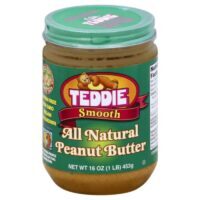
- All-natural peanut butter, such as Teddie, is less processed than conventional brands, such as Skippy. All brands of PB need to meet the USDA’s “standard of identity.” Conventional brands might have 2% added saturated fat (palm oil, hydrogenated oils) to control the oil from separating. This small amount does not over-ride the positive health benefits of PB. Any PB is better than no PB.
- Sugar added to conventional brands is relatively insignificant. The 2 or 3 grams of added sugar is nothing compared to the 10 to 15 grams of sugar in the jelly or honey you might enjoy with the PB, or the 6 grams of sugar in the sandwich bread. Please fret less about added sugar—it is burned for muscle fuel—and focus more on PB’s vitamin E, zinc, folate, niacin, and selenium. PB is nutrient-rich.
- Salt added to PB is relatively insignificant. The 150 milligrams of sodium (a part of salt) in a serving of PB is less than the sodium you get in a slice of bread or 12-ounces of Gatorade. Regardless, that sodium replaces what you lose in sweat.
In conclusion, what more could you ask from a super sports food?
Nancy Clark MS RD CSSD, a fan of Teddie peanut butter, counsels both fitness exercisers and competitive athletes (617-962-4382). Her best-selling Sports Nutrition Guidebook is a popular resource. For more information, visit NancyClarkRD.com